
Etsy’s handmade policy has allowed for outside production help since 2013. The panic you’re feeling now isn’t because the rule changed; it’s because AI and print-on-demand (POD) have turned that small exception into a loophole big enough to drive a container ship through.
The core problem for a true handmade seller isn’t the existence of a single AI-generated t-shirt design. It’s the speed and scale at which one person can now flood a category with thousands of algorithmically-generated, zero-inventory listings. This shift is fundamentally changing the platform’s character, burying real craftsmanship under a mountain of digital lookalikes and directly impacting your sales. So, what is Etsy’s real identity now, and how do you survive on a platform that seems to reward scale more than skill?
- Etsy’s policy has allowed “production assistance” for over a decade. AI and POD are just the most extreme, scalable versions of this.
- The real threat isn’t a single AI-generated design, but the ability for one shop to list thousands of POD items with minimal effort, drowning out handcrafted goods.
- Etsy’s enforcement is inconsistent. They’ve made statements about cracking down on AI-generated art and resellers, but sellers report that thousands of these listings remain active.
- This hyper-competition increases the risk of unsold inventory for handmade sellers. Your unique, slow-made items get less visibility and are more likely to become dead stock.
- To compete, focus on what can’t be scaled: unique physical textures, detailed craftsmanship videos, personalized options, and a brand story that a POD shop can’t fake.
What Etsy’s “Handmade” Policy Actually Says
Let’s be exact. Etsy’s current Handmade Policy states that everything listed as handmade must be made and/or designed by you, the seller. The “and/or” is doing a lot of work there. If you design an item, you are allowed to use a “production partner” to help create the physical product. This was originally intended for people like jewelers who designed a piece and used a casting house to produce it, or illustrators who used a local print shop for their art prints.
The policy itself is not new. What’s new is the technology. A print-on-demand service is a production partner. An AI image generator is a design tool. A shop using both can argue they are following the letter of the law: they “designed” the art with an AI prompt and used a POD company as their “production partner.”
This is where the spirit of the policy and the reality of the platform diverge. A seller spending 40 hours carving a wooden bowl and a seller spending 40 seconds writing a Midjourney prompt are operating under the same “handmade” banner. This is the source of the identity crisis. As YouTuber Kara Buntin points out, the lines have become incredibly blurry, and Etsy’s own definitions leave massive room for interpretation.

The Real Threat: Not a Tool, But Infinite Scale
Focusing on whether AI is a legitimate “design tool” misses the point. The real issue is scale. Before, even with production partners, there were physical and financial limits. You had to order a minimum run, pay for it upfront, and store it. There was real risk involved.
POD and AI remove that risk entirely. A single seller can now:
- Generate hundreds of “unique” designs in an afternoon.
- Use software to automatically create mockups for dozens of products (t-shirts, mugs, posters, blankets).
- Create thousands of listings with no upfront cost and zero physical inventory.
This isn’t competition; it’s a flood. Your single, carefully photographed, handmade ceramic mug is now competing in search results with 5,000 algorithmically generated mugs from a shop that opened last Tuesday. These shops can afford to play a pure numbers game, testing thousands of designs and keywords to see what hits. A real maker with physical inventory can’t do that.
Etsy’s Enforcement Problem is Your Visibility Problem
So, what is Etsy doing about it? Their actions have been confusing and, to many sellers, insufficient. In early 2023, Etsy updated its policy to be more explicit about AI, requiring sellers to disclose when their images are AI-generated. Yet, enforcement seems spotty at best. There was talk of Etsy banning AI-generated art, but the reality is more nuanced and mostly focuses on disclosure.
Simultaneously, Etsy CEO Josh Silverman has been publicly contrasting Etsy’s “special” items with mass-produced goods from Amazon and Temu. This creates a disconnect for sellers who see their search results filled with items that look suspiciously like they came from those very sites.
This isn’t just a philosophical problem. It’s a practical one. When rule-breaking or rule-bending shops are allowed to dominate search, your high-quality, policy-compliant listings get pushed down. Fewer views mean fewer sales. And fewer sales mean the beautiful inventory you spent time and money creating is now just sitting on a shelf.
How Platform Shift Creates Unsold Inventory
This is the direct connection between Etsy’s identity crisis and your balance sheet. The rise of low-effort, high-volume shops makes the market less predictable for everyone else.
Here’s the chain reaction:
- Search Dilution: Your “rustic farmhouse sign” is now competing with thousands of POD signs using the same keywords, burying you on page 12.
- Price Erosion: POD sellers with no inventory costs can price their goods extremely low, anchoring customer price expectations at an unsustainable level for a true craftsperson.
- Reduced Visibility: The Etsy algorithm may favor shops with thousands of listings and constant activity, further penalizing smaller, slower-moving handmade shops.
- Increased Dead Stock: You made 20 ceramic planters based on last year’s sales data. This year, visibility dropped 50% due to new competition. You now have 15 unsold planters tying up your cash and space.
This is the exact pain we built Swappair to address. Unsold inventory is a direct consequence of market risk, and that risk is increasing. Swapping is one tool for dealing with this—it works when the product is good, but the market has become too crowded or unpredictable. It’s for turning quality, finished goods that are stuck into materials you need or fresh inventory for your shop. It is not a fix for a flawed product or your perennial best-seller that just had a slow month.
Survival Strategy: Lean Into What Can’t Be Faked
You cannot out-scale a POD shop. Complaining about Etsy’s policies is valid, but it won’t pay your bills. The only winning move is to make the comparison irrelevant. Focus entirely on the things that a scalable, digital-first shop cannot replicate.
Double Down on Physicality and Proof
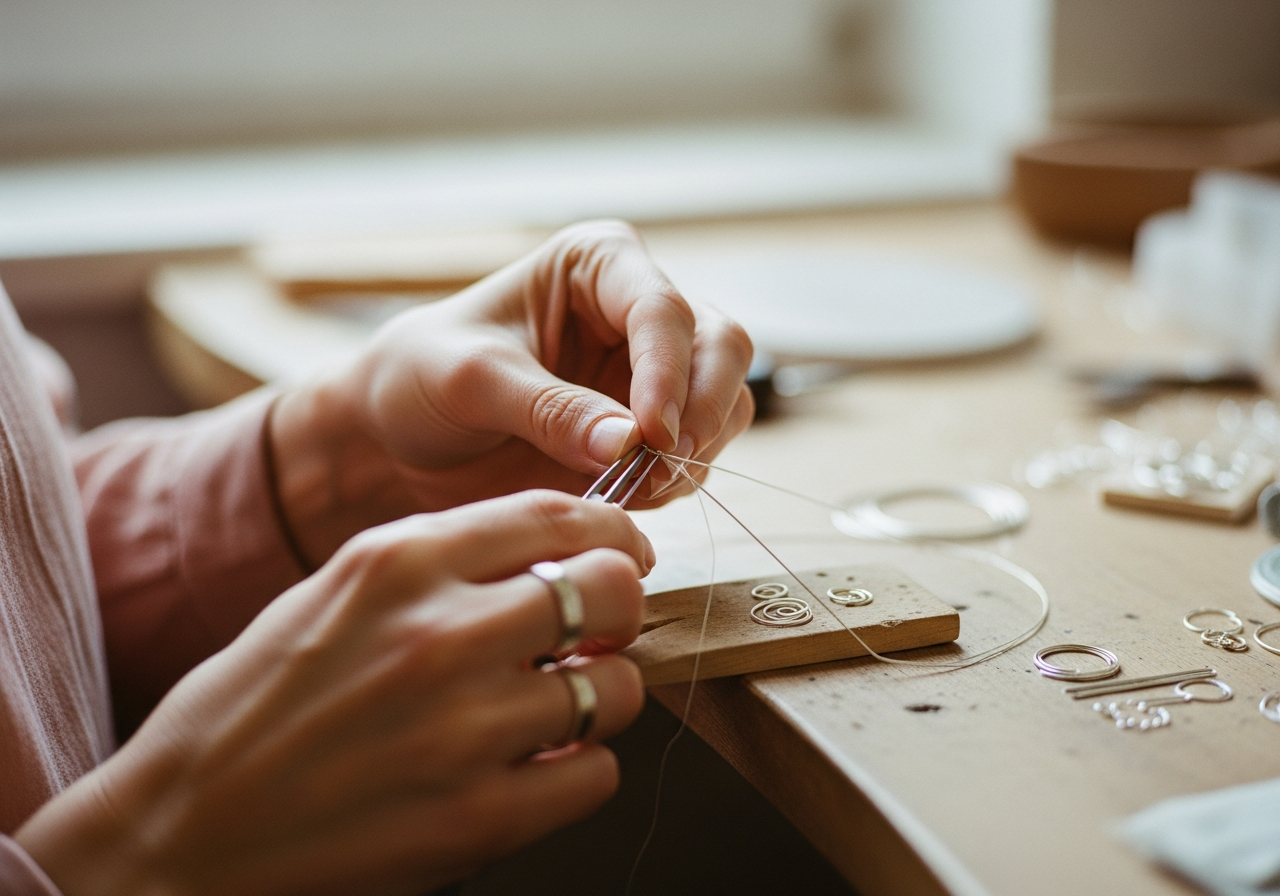
A POD shop can generate a beautiful mockup. They cannot show a video of a real human hand-stitching a leather wallet. They cannot do a macro shot of the unique glaze on a piece of pottery. Your product photos and videos are no longer just for showing the item; they are for proving its authenticity.
- Show the process: Don’t just say it’s handmade, prove it. Add a 10-second video to your listing showing you burnishing the edge of a leather good, mixing a custom glaze, or weeding a vinyl decal. This instantly builds trust and justifies your price.
- Highlight materials: Be painfully specific. Not just “wood,” but “hand-sanded spalted maple.” Not just “yarn,” but “hand-dyed merino wool from a small farm in Vermont.” This is a language POD sellers cannot speak.
- Emphasize texture: Your photography must make someone want to touch the item. Use angled light to show the weave of a fabric. Get close enough to see the brush strokes on a painting. Make the digital feel physical.
The goal is to make a customer feel that buying from you is buying a real object from a real person, while buying from the other shop is just ordering a file to be printed on a blank.
FAQ
Is Etsy banning all AI art?
No. Etsy’s policy requires sellers to design their own items, and they consider AI to be a design tool. However, sellers must disclose the use of AI-generated content in their listings, and the final product must still comply with all other policies (e.g., not infringing on intellectual property).
Does using a print-on-demand service violate Etsy’s handmade policy?
No, as long as you are the original designer of the work being printed. POD companies are considered “production partners” under Etsy’s policy. The controversy comes from AI-powered shops that do minimal design work and use POD to list thousands of items.
How can I make my handmade items stand out against POD products?
Focus on what they can’t do. Use high-quality video to show your creation process. Take detailed, textured photos that prove your item is a physical object you hold in your hands. Offer personalization options that require real manual work. Build a brand story around your craft and expertise.
I reported a shop that is clearly a reseller, but nothing happened. Why?
Etsy’s enforcement is notoriously opaque and can be slow. They receive a massive volume of reports, and proving a shop is a reseller versus a legitimate designer with a production partner can be difficult from the outside. While you should still report clear violations, don’t count on it as your primary strategy for success.
Is it still worth it to sell truly handmade goods on Etsy?
It depends on your product and strategy. For many, yes, because Etsy still has a huge built-in audience searching for unique goods. But you can no longer simply list a good product and expect it to be found. You must actively differentiate yourself from the low-effort competition by proving your authenticity and building a strong brand connection with buyers.
What should I do with inventory that isn’t selling because of this new competition?
First, be honest about why it isn’t selling. If the photos are bad or the SEO is weak, fix those things first. If it’s a perennial bestseller that’s just in a slump, be patient. But if the product is genuinely good and well-listed, but stuck in a newly saturated market, you have a few options: run a deep discount sale (which can devalue your brand), try a destash sale on Instagram (lots of work for a small audience), donate it, or swap it. Swapping on a platform like Swappair makes sense when you want to trade your good-but-stuck inventory for something of equal value—like materials or different finished goods—without taking a huge financial loss.
The platform has changed. Etsy is no longer just a craft fair; it’s a technology platform where scale is a powerful advantage. This doesn’t mean craft has no place, but it means the strategy has to evolve. Your story, your process, and the physical proof of your hands-on work are now your most important assets.
So here is the question: if the platform itself won’t protect the value of “handmade,” how will you?